AboutContactPrivacy PolicyAffiliate DisclosureTerms of Use
Hot News

Leatherman Wave+ Review: The Multi-Tool That Earns Its Pocket Space

Disclosure: This post contains affiliate links. If you buy through them, we may earn a commission at no extra cost to you. This review is based on research, manufacturer specs and published owner and expert feedback, not hands-on testing.

Leatherman Wave multi-tool with the saw, files and pliers opened out

The Leatherman Wave with its tools fanned out: two saws, files, a bottle opener, and the pliers at the center. Image: brian.ch via Flickr, CC BY 2.0

A good multi-tool is the one you actually carry. It has to be small enough for a belt or pocket and strong enough to do real work. The Leatherman Wave+ has been a top pick for years because it hits that balance. It has 18 tools in a full-size body, and the pliers are the main reason people love it.

A note on the photos below: they show the earlier Wave, the tool the Wave+ grew from. The two share the same layout and body, and the Wave+ adds replaceable wire cutters and a few small changes. We describe those differences in the text.

What You Get

The Wave+ is a full-size multi-tool made in Portland, Oregon, with a 25-year warranty from Leatherman. It folds to about 4 inches and weighs roughly 8.5 ounces. The stainless steel handles are strong and a bit heavy for a shirt pocket, so most owners carry it in the included nylon sheath on a belt.

It has 18 tools. The main ones are needlenose and regular pliers, replaceable wire cutters, hard-wire cutters, a knife blade, a serrated blade, a saw, a file, scissors, a bit driver, an awl, a can and bottle opener, and a ruler marked on the handle. Many of the tools are reachable from the outside, so you can open them without opening the pliers.

The Pliers and Cutters

The pliers are the best part of the Wave+. The jaws are strong and the needlenose tips reach into tight places. The built-in wire cutters are replaceable, which means you can change them when they wear out. That is the main upgrade from the earlier Wave.

The pliers grip well, and the handles are shaped so the squeeze does not hurt for a short job. They will not replace a full-size pair of pliers on a hard job, but for fence wire, electrical work, and small repairs, they are more than enough.

Leatherman Wave multi-tool folded open as pliers on a wooden table

The Wave opened into pliers. The stainless handles fold around the tools when closed. Image: Andy / Andrew Fogg via Wikimedia Commons, CC BY 2.0

Knives, Saw, and the Rest

The knife blade is a 420HC stainless steel that holds an edge well and sharpens easily. The serrated blade handles rope and cardboard. The saw is rated for small branches and plastic pipe, and the file smooths edges on metal and wood.

The scissors are spring loaded and open on their own after each cut, and they trim thread, paper, and tape neatly. The bit driver accepts standard bits, so you can swap in a Phillips or flat tip for small screws.

Most blades lock open, which is an important safety feature. The tools flip out one at a time, and the locks are solid. Accessing the tools takes a bit of practice, since the nail nick is small. A little time with the tool shows how each one works.
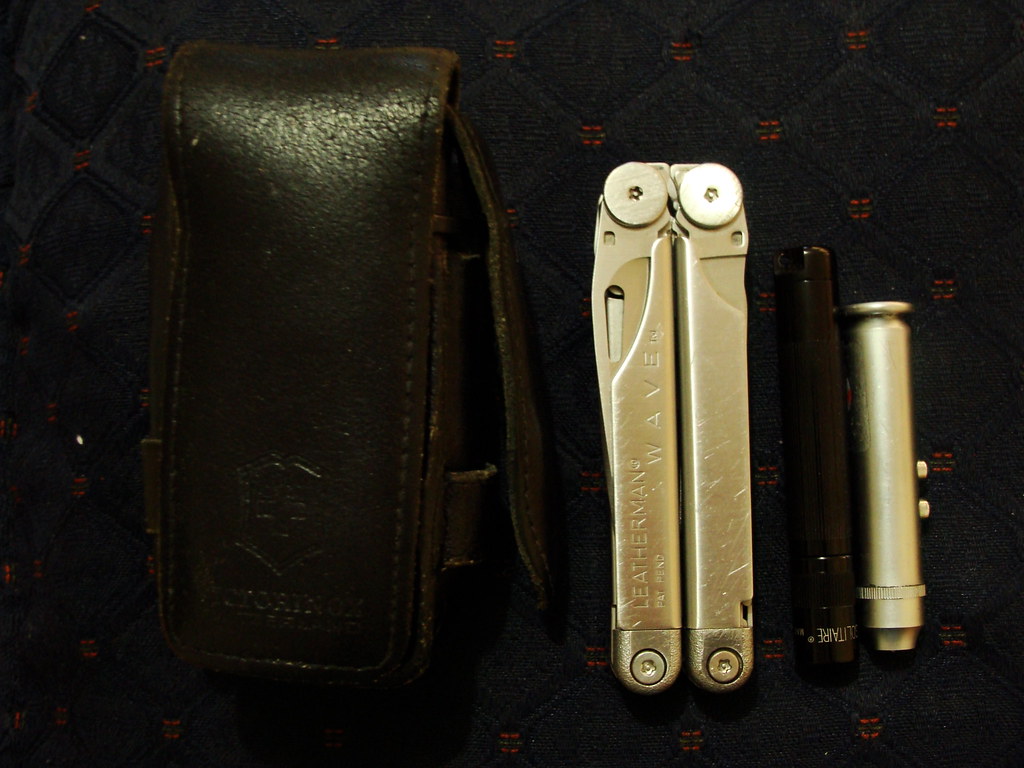
Leatherman Wave in its leather sheath beside a small flashlight

The Wave next to its leather sheath and a pocket light, which shows how compact the tool is when closed. Image: FRANZ 64 via Flickr, CC BY-SA 2.0

Where It Falls Short

It is big. At roughly half a pound, it is a belt tool, not a pocket tool, and it is not allowed in many places such as airplanes and some workplaces. If you need a lighter carry, a smaller Leatherman is a better choice.

It is also expensive compared to basic multi-tools. The price reflects the build quality and the warranty, but a casual user may not need what the Wave+ offers. And as with any multi-tool, the tools are compromises. The saw is short, the screwdriver tips are small, and the handles are not as comfortable as a dedicated tool for long jobs.

How It Compares

The closest rivals are the Leatherman Surge, which is bigger and stronger, and the Victorinox SwissTool, which is a classic with a different design. The Wave+ sits in the middle: easier to carry than the Surge and more capable than a small tool like the Leatherman Wingman. For many people, that is the right balance.

If you are choosing a color, stainless is the standard finish, and black is a coated version that looks darker. The tools are the same in both.

Care and Carry

Stainless steel does not rust easily, but the tool still needs care. Rinse off salt, sand, and mud, dry the tool, and put a drop of light oil on the pivots. The joints stay smooth for many years with that routine.

Sharpen the knife with a small stone and a light touch. Use a pocket sharpener for the serrated edge, and keep the blades clean so they open freely. Check that the pliers close evenly and that the locks hold.

Think about where you carry it. A belt sheath keeps the weight off your pocket, and a small pouch in a backpack protects the tool and your other gear. Most people find that carrying it every day teaches them how often a good tool helps.

Who Should Buy It

This is a great tool for campers, DIY fans, tradespeople, and anyone who wants a single tool for small fixes on the go. It is also a great gift, since the warranty gives peace of mind.

If you carry a tool for light jobs only, or if you travel by air often, a smaller model will suit you better.

Pros and Cons

Pros

  • Strong pliers with replaceable wire cutters
  • 18 tools in one body
  • Most blades lock and are accessible from outside
  • Made in the USA with a 25-year warranty
  • Good balance of size and capability

Cons

  • Heavy for a pocket
  • Expensive for casual use
  • Not allowed in many places
  • Tool nicks are small and take practice

Verdict

The Leatherman Wave+ is a sturdy, well-made multi-tool that earns its place on a belt or in a bag. The pliers are excellent, the tools are useful, and the warranty is solid.

If you want one tool that handles many small jobs, this is a top pick.

View at Amazon

Channellock 440 12-Inch Tongue and Groove Pliers Review: The Plumber Favorite

Disclosure: This post contains affiliate links. If you buy through them, we may earn a commission at no extra cost to you. This review is based on research, manufacturer specs and published owner and expert feedback, not hands-on testing.

Channellock 12 inch tongue and groove pliers with blue handles on concrete

The Channellock 12-inch tongue-and-groove pliers with the long blue handles. Image: J.C. Fields (Talk) (Uploads) via Wikimedia Commons, CC BY-SA 3.0

If you have ever watched a plumber work, you have probably seen a pair of blue-handled pliers with long arms. Those are Channellock tongue-and-groove pliers, and the 12-inch Model 440 is one of the most common sizes. They grip pipe, nuts, fittings, and round stock, and they open wide enough to handle things regular pliers cannot.

We looked at the 440 for what it does well, where it is awkward, and whether it earns a place next to your wrenches.

What You Get

The 440 is a straight-jaw tongue-and-groove plier, 12 inches long. Channellock makes its pliers in Meadville, Pennsylvania, and the brand is known for the blue grips. The pliers are made from high-carbon steel, and the jaw teeth are heat-treated to stay sharp.

The tongue-and-groove design means one handle has a series of grooves, and the other has a tongue that slides into them. You pick a groove to change the jaw opening. The pliers open to roughly 2.5 inches at the widest setting, which is large enough for a 2-inch pipe.

Grip and Leverage

The long handles are the main reason people pick the 440. The extra length gives leverage for stubborn fittings, and the jaws bite into round metal instead of slipping off. For a tight slip nut under a sink, or a large PVC fitting, the extra reach is a real help.

The teeth are cut at an angle, so the jaws grip round surfaces well and flat nuts less so. For a hex nut, use a wrench when you can. Tongue-and-groove pliers will round off a bolt head if you force them.

The parallel jaw action is smooth. You can slide the pliers to a new groove with one hand, and the jaws stay parallel to the work when you squeeze. That keeps the grip steady when you are turning a pipe in a tight space.

Channellock pliers held over a toilet tank

A pair of Channellock tongue-and-groove pliers on a plumbing job. Wide jaw opening is the point of the design. Image: pmarkham via Wikimedia Commons, CC BY 2.0

Everyday Uses

In a home shop, these pliers earn their place quickly. Sink drain nuts, garden hose fittings, and compression nuts all come off easier with the long arms. They also work for holding a round part steady while you turn another part with a wrench.

Auto and farm owners often keep a pair too. A stuck radiator hose clamp, a seized bolt on an old trailer, or a rusted fitting on a tractor all respond well to a strong grip with long handles. For electrical work, do not use them as a replacement for insulated tools, because the grips are not rated for live work.

Channellock GripLock tongue and groove pliers on concrete

A shorter Channellock GripLock model from the same family, shown for size comparison against the 12-inch pair. Image: J.C. Fields (Talk) (Uploads) via Wikimedia Commons, CC BY-SA 3.0

Owners describe the grips as fine for short jobs but not cushioned for hours of use. Wear gloves for heavy work, and the pliers will be easier on your hands.

Where It Falls Short

At 12 inches, the 440 is large. It will not fit in a small tool bag and it is awkward in tight spaces. For small jobs, a 9.5-inch or 10-inch model is easier to control. Many people end up with two sizes.

The pliers can mar chrome and soft finishes. If you are working on a visible chrome pipe, wrap the jaws with tape or use a strap wrench. The teeth will leave marks that do not come off.

And the pliers can slip if the jaws are dirty or worn. Over many years of hard use, the teeth will dull. They are made to last, but they are not a precision tool.

How It Compares

The obvious rival is the adjustable wrench. A wrench fits flat nuts better, but it has a narrow opening and cannot grip round pipe. Pipe wrenches grip round stock harder and are better for rusted steel, though they chew up softer fittings. Tongue-and-groove pliers sit between the two: wide, easy to adjust, and gentle enough for plastic and brass if you are careful.

If you are choosing between sizes, the 10-inch Model 430 is easier to carry, and the 12-inch Model 440 gives more leverage and a wider opening. A pair of each covers nearly any job around a house or a small shop.

A tip on care: wipe the pliers dry after wet work and put a drop of oil on the pivot now and then. The grooves collect grit, and a clean pivot keeps the adjustment smooth for years.

Who Should Buy It

Homeowners who do their own plumbing, mechanics, and anyone who wants one big pair of pliers for general work will use the 440 often. If you only own one pair of pliers for pipes and fittings, this is a better choice than a small adjustable wrench.

If you mostly work on small electronics, models, or tight engine bays, look at a smaller size. The 440 is a heavy-duty tool, not a delicate one.

Pros and Cons

Pros

  • Long handles give strong leverage
  • Wide jaw opening handles larger pipes
  • Made in the USA with heat-treated teeth
  • Smooth, parallel jaw action
  • Durable enough to last for years

Cons

  • Large and awkward in tight spaces
  • Teeth can mark chrome and soft metals
  • Not suited to hex nuts when a wrench fits
  • Grips are not insulated for electrical work

Verdict

The Channellock 440 is a long, tough, simple pair of pliers that does a job few tools do as well. It earns its reputation among plumbers and DIY users alike.

If you want one big pair of pliers that can handle pipes, fittings, and stuck parts, buy the 440. Add a smaller size later for tight spots.

View at Amazon

Irwin Quick-Grip One-Handed Bar Clamp Review: The Third Hand Every Shop Needs

Disclosure: This post contains affiliate links. If you buy through them, we may earn a commission at no extra cost to you. This review is based on research, manufacturer specs and published owner and expert feedback, not hands-on testing.

Irwin Quick-Grip one-handed bar clamp on a concrete floor

An Irwin Quick-Grip one-handed bar clamp. The trigger grip is what lets you tighten it with one hand. Image: J.C. Fields (Talk) (Uploads) via Wikimedia Commons, CC BY-SA 3.0

Most clamps ask for two hands. You hold the work with one and crank the screw with the other, and the piece slips while you do it. The Irwin Quick-Grip One-Handed Bar Clamp was built to fix that. You squeeze a trigger with one hand and the jaw ratchets forward until the work is held.

We looked at the 12-inch medium-duty model, the one most woodworkers and DIY builders buy first. Here is what it does well, where it runs out of strength, and whether it deserves a spot on your wall.

What You Get

The clamp has a flat steel bar, a fixed jaw at one end, and a sliding jaw with a pistol-style handle. Squeezing the handle moves the sliding jaw along the bar. A small release trigger lets the jaw slide back or fall away fast. The jaws have soft pads that protect the surface of the wood.

The 12-inch size gives a 12-inch opening, and the throat depth is about 3 inches. That is enough for cabinet doors, small frames, shelves, and most project boards. Longer sizes are sold in the same line, and the same design works in all of them.

Using It With One Hand

The best feature is also the simplest. You line up two boards with one hand, set the clamp across them with the other, and squeeze. There is no screw to turn and no handle to spin. The clamp closes in a second.

That sounds minor until you glue up a project alone. Holding a board flat, keeping a joint aligned, and adding a clamp without moving anything is a chore with screw clamps. With the Quick-Grip it is almost easy. It also works well for holding a workpiece to a bench while you drill, sand, or saw.

The pads are soft enough not to leave dents in pine or poplar. For delicate surfaces, a small scrap of wood between the pad and the work is still smart, because any clamp can mark the surface if you squeeze too hard.

Pressure and Holding Power

A bar clamp with a ratchet grip is not a vise. The Quick-Grip is rated by Irwin for medium-duty work, and it gives plenty of force for glue-ups and light assembly. For a large panel glue-up or a thick hardwood joint, a heavy pipe clamp or a parallel-jaw clamp will give more even and stronger pressure.

Be careful not to over-tighten. Because the trigger is easy to squeeze, it is easy to keep squeezing. Too much force can bow a thin board or squeeze all the glue out of a joint, which makes a weak bond. Tighten until the joint closes and a small bead of glue shows, then stop.

Irwin Quick-Grip bar clamp standing on its end outdoors

A Quick-Grip clamp standing on the fixed jaw. The sliding jaw can be flipped around to spread instead of clamp. Image: R. Henrik Nilsson via Wikimedia Commons, CC BY 4.0

One more useful feature is the spreader mode. On many Quick-Grip clamps, you can remove the sliding jaw and reinstall it facing the other way. Then the clamp pushes outward instead of pulling inward. That helps when you need to nudge a frame square, hold a joint open, or push two parts apart for a repair.

Where It Falls Short

The ratcheting action can slip under heavy load, and the plastic parts on the handle and jaw are not made for abuse. If you drop it on concrete or crank it in a hard glue-up, parts can crack over time. A steel screw clamp will outlast it in hard use.

The bar is thin, so a long clamp can flex. For a wide panel, the pressure in the middle will be weaker than at the ends. Use cauls or extra clamps in those cases.

Finally, the clamp is not a precision tool. The jaws are not perfectly parallel under load, and the pads are not designed to hold a piece dead square. For cabinet frames, check your corners with a square after clamping.

Alternatives Worth Knowing

The main rival is the classic screw-type bar clamp, such as a Bessey or a pipe clamp. Those cost more per clamp and take two hands, but they apply far more force and hold it for days. If you glue up tabletops or doors, you will want a few.

Another option is a Quick-Grip in a different size. The 6-inch mini version is handy for small boxes and trim, and the 24-inch and 36-inch versions cover wider panels. Buying a mixed set gives the best value, because most projects need clamps of different lengths.

Irwin Quick-Grip bar clamp on a white background

The clamp on a plain background shows the steel bar, the pad on each jaw, and the release trigger below the handle. Image: w:en:File:Irwin Quick-Grip bar clamp.jpg: J.C. Fields derivate work: User:Westbahnhof via Wikimedia Commons, CC BY-SA 3.0

Whatever you pick, keep the pads clean. Dried glue on the pad will transfer to the next project and can leave a mark on fresh wood. Wipe the pads with a damp rag after each glue-up.

Who Should Buy It

If you work alone, glue small projects, build furniture, or often need a second pair of hands, this clamp is an easy pick. A set of four or six in mixed sizes covers most small shop needs. It is also a good choice for a beginner, because it is simple, inexpensive, and does not need any training to use.

If your work is heavy panel glue-ups or timber framing, buy heavier clamps for those jobs and keep the Quick-Grip for everything else. Most shops end up with both kinds.

Pros and Cons

Pros

  • True one-handed operation
  • Fast to place and fast to release
  • Soft pads protect the work
  • Can be used as a spreader
  • Inexpensive enough to buy several

Cons

  • Medium-duty pressure only
  • Plastic parts can crack if abused
  • Long bars can flex under load
  • Easy to over-tighten a thin board

Verdict

The Irwin Quick-Grip One-Handed Bar Clamp is the clamp that makes working alone practical. It will not replace heavy bar clamps for large glue-ups, but for everyday shop and home projects it is hard to beat for the price.

Buy a few. You will use them more often than you expect, and the second and third clamp make the biggest difference.

View at Amazon