
Fluke 87V Digital Multimeter Review: The Meter Pros Still Trust
Disclosure: This post contains affiliate links. If you buy through them, we may earn a commission at no extra cost to you. This review is based on research, manufacturer specs and published owner and expert feedback, not hands-on testing.
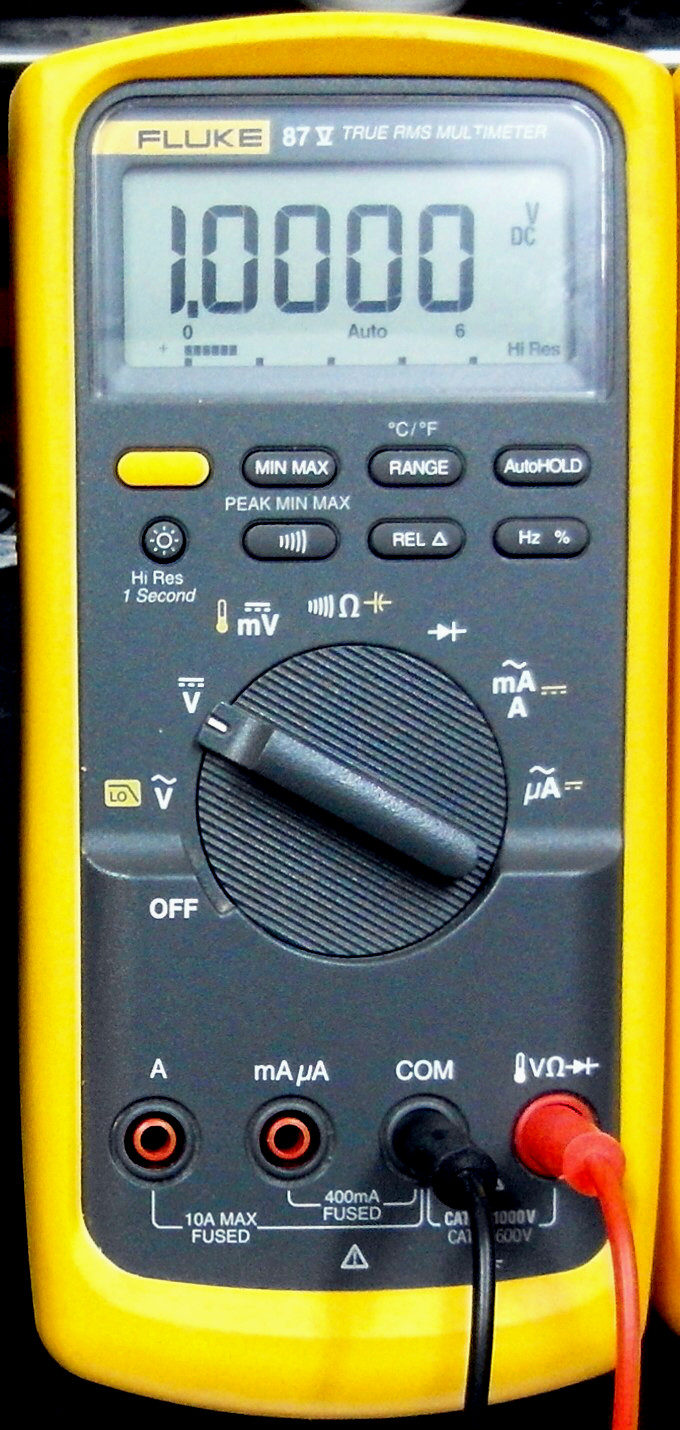
The Fluke 87V with its yellow holster, large display, and rotary dial. Image: Binarysequence via Wikimedia Commons, CC BY-SA 3.0
A multimeter is one of those tools where the cheap version works until the day it does not. The Fluke 87V is the opposite of cheap. It costs several times more than a basic meter, and it has been a standard in electrical, HVAC, and industrial work for decades.
We looked at what the extra money buys, what the 87V does that a budget meter cannot, and who really needs one.
What You Get
The 87V is a true-RMS digital multimeter rated for CAT III 1000 V and CAT IV 600 V environments. In plain terms, it is built for work in panels and equipment where a surge can be dangerous. The kit includes test leads, alligator clips, and a temperature probe, plus a protective yellow holster.
It measures AC and DC voltage and current, resistance, capacitance, frequency, duty cycle, and temperature. It also has a diode test and a continuity beeper. Features that are rare on budget meters include a min/max/average recording mode and a low-pass filter for measuring variable-speed drive output.
Accuracy and Readability
True-RMS means the meter measures the real heating value of an AC waveform even when it is not a clean sine wave. Many cheap meters assume a sine wave and give wrong readings on modern electronics, dimmers, and motor drives. The 87V reads those correctly.
The display is large, with a backlight, and the dial is easy to read. Digits are steady and the meter responds fast. For testing a circuit, you see the number settle quickly, which saves time and avoids doubt.
Accuracy on DC volts is rated at 0.05 percent, which is far better than the typical 0.5 percent of a budget meter. For most home work, that difference does not matter. For calibration, electronics repair, and industrial troubleshooting, it does.

A Fluke 87 series meter on a bench. The display and dial layout is the same family as the 87V. Image: Steve C via Wikimedia Commons, CC BY 2.0
Safety and Build
The safety rating is the real reason many professionals pay the price. The meter has fused inputs, shrouded jacks, and an internal design tested to resist a surge. A cheap meter with no real rating can fail badly if you measure a live panel and a spike comes through.
The holster protects against drops, and the case is tough. Many 87 series meters have worked for 20 years or more with only battery changes. The test leads are good quality, though the included clips are basic.

The front panel of a Fluke 87 meter. Buttons sit above the dial and the input jacks are at the bottom. Image: Alex P. Kok via Wikimedia Commons, CC BY-SA 4.0
Fluke also offers a calibration service, so a meter can be certified again and kept in service for a long time. That is another reason the cost spreads out over years.
Where It Falls Short
The 87V is large and heavy compared to a pocket meter. It does not fit in a shirt pocket, and the holster adds more bulk. For quick checks in a house, it is more meter than you need.
It also has no wireless connection or app logging in this version. Newer Fluke models add Bluetooth and data logging. If you want to record readings to a phone, look at a newer model.
And of course, the price is high. A solid mid-range meter costs a fraction of the 87V and handles most household jobs. Only buy this one if you need its accuracy, its safety rating, or its professional features.
How It Compares
The main alternative is a mid-range meter from brands like Klein, Extech, or Amprobe. They cost much less and cover the basics. Many are accurate enough for household work, and some include a safe CAT III rating. What they do not match is the long-term durability, the fast display response, and the extra functions of the Fluke 87V.
Some people also consider a clamp meter, which measures current without breaking the circuit. A clamp meter is a good addition for electricians, but it does not replace a full multimeter for resistance, capacitance, or low-voltage electronics.
A practical note: buy genuine Fluke from an authorized seller. Counterfeit meters exist, and a fake meter with a false safety rating is a real hazard. Check the seller and the packaging before you rely on one in a live panel.
Who Should Buy It
Electricians, HVAC technicians, maintenance workers, and serious electronics hobbyists get the most from the 87V. If you test live panels, work with motor drives, or need trusted readings, it pays for itself in confidence and long service life.
A homeowner who checks outlets and batteries a few times a year can buy a cheaper meter. Just make sure that any meter you use on mains has a proper CAT rating from a reputable brand.
Pros and Cons
Pros
- True-RMS accuracy on non-sinusoidal signals
- CAT III 1000 V and CAT IV 600 V rating
- Fast, steady, easy-to-read display
- Built to last for many years
- Min/max and low-pass filter for advanced work
Cons
- Expensive compared to general-use meters
- Large and heavy for pocket use
- No wireless logging in this version
- Overkill for basic household checks
Verdict
The Fluke 87V is the meter you buy once. It is accurate, safe, and tough, and the professional features justify the price for people who depend on their readings.
For casual home use, a cheaper meter is enough. For anyone who works with electricity for a living or as a serious hobby, the 87V is a sound investment.